%20-%20All%20Logos_Primary%20-%20Full%20Color.png)
Create a World-Class New Parent Experience

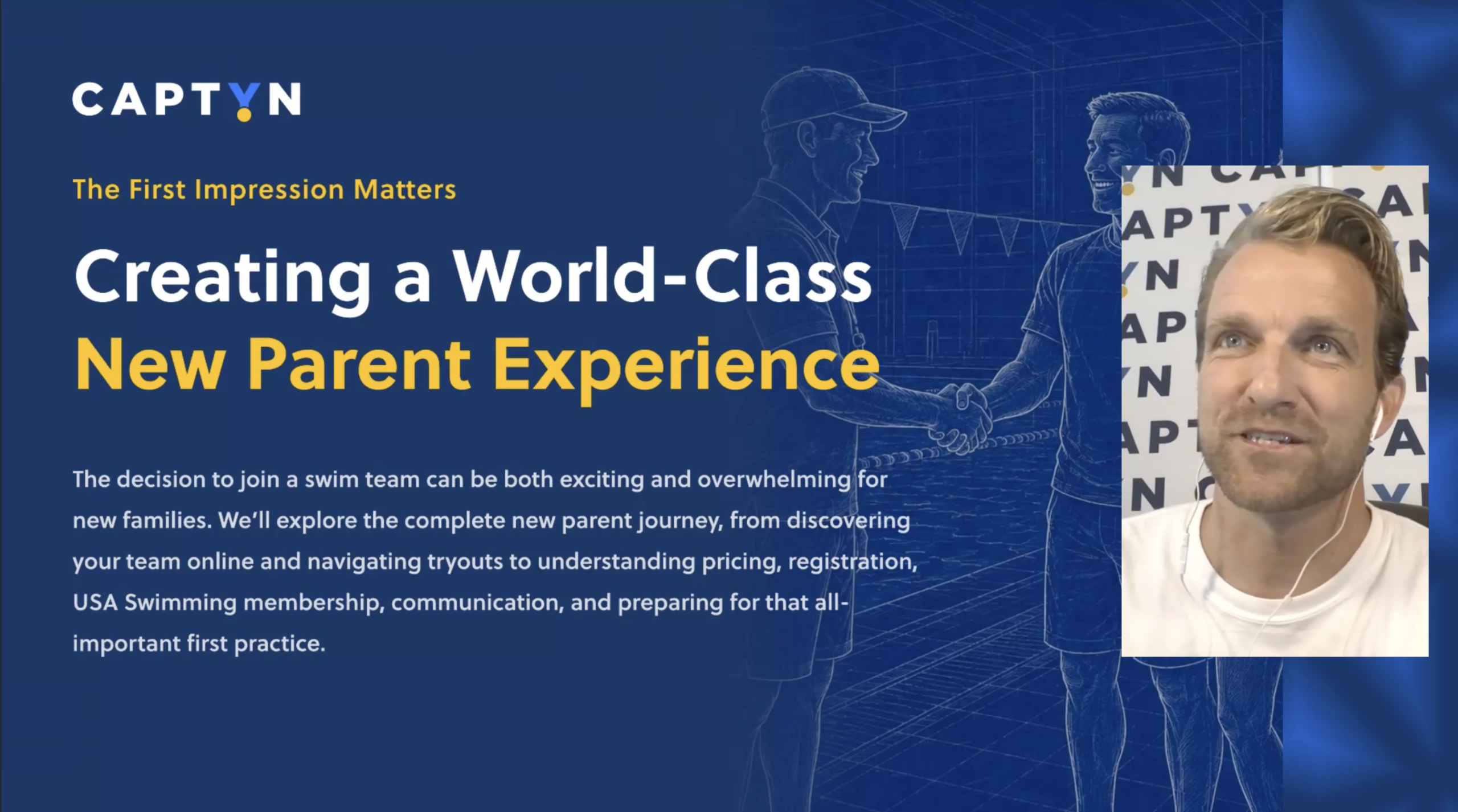

Introduction to the New Parent Experience
First impressions matter.
For a new swim family, joining a team can feel exciting, intimidating, and overwhelming all at once. The swimmer may be ready to jump in, but the parent is trying to answer a long list of questions:
- Is this the right team for my child?
- What group should they join?
- How much does it cost?
- Do we need a tryout?
- What equipment do we need?
- Where do we go on the first day?
- What is USA Swimming?
For swim teams, this moment matters more than many realize. A new swimmer can represent years of participation, tuition, meet fees, volunteer hours, referrals, and family engagement. But that long-term value often depends on what happens in the first few weeks and months.
The best swim teams treat the new parent experience like a playbook. They do not leave it to chance. They build a clear, mobile-friendly, low-friction journey that helps parents feel informed, welcomed, and confident from the first click to the first practice.
The goal is simple:
Make joining the team feel easy. Make the first practice feel exciting. Make ongoing management feel effortless.
When you do that well, you do not just gain a swimmer. You earn a family’s trust.
Understanding the New Swim Parent
Before you can build a better onboarding process, you have to understand who you are designing it for.
The new swim parent is usually not a former college swimmer. They may call butterfly “butter” for short because thats how you abbreviate all the other strokes. They may have only experienced summer league swimming, swim lessons, or another youth sport. They are not yet fluent in swim team language, USA Swimming requirements, meet entries, practice groups, or volunteer commitments.
They are also busy.
Today’s parents are managing work calendars, school calendars, after-school activities, emails, text alerts, lunch apps, pickup apps, classroom portals, sign-up forms, and family logistics. Many already have four or five logins just to manage one child’s school experience.
That matters because your swim team is not entering a blank space in their life. You are becoming one more activity they have to manage.
A few things are especially important to remember:
- They live on their phone. Their passwords, credit cards, calendars, and autofill settings are already there. If registration can happen on a phone, that is where they want to do it.
- They are already overwhelmed by email. More communication is not always better. Better communication is better.
- They may not understand swimming yet. Terms that feel obvious to coaches may be confusing to parents.
- They care most about their child. They are not thinking about your administrative process. They are thinking about whether their swimmer will feel comfortable, safe, prepared, and successful.
- They value time as much as money. If signing up is difficult, some parents will simply choose a different activity. They don’t need more frustration and emails.
The best approach is to design the experience for the parent who knows nothing about swimming. If that parent can move through your process with confidence, every other parent can too.
Creating a Seamless New Parent Onboarding Process
A seamless onboarding process removes unnecessary friction.
That does not mean every detail has to be simple behind the scenes. Swim team registration, billing, group placement, USA Swimming membership, meet participation, and parent communication can all be complex. But the parent experience should not feel complex.
A good rule of thumb is this:
Make the online experience forgettable. Make the pool experience unforgettable.
Parents should not remember your registration process because it was confusing, repetitive, or frustrating. They should remember the first smile from a coach, the high five on deck, the clear welcome email, and the way their swimmer left practice excited to come back.
A strong onboarding process should:
- Work smoothly on mobile
- Ask for information once
- Guide parents into the right path
- Make tryouts easy to schedule
- Make direct registration easy to complete
- Eliminate SWIMs registration
- Trigger timely email and text communication
- Prepare families before the first practice
- Give parents one clear place to manage the activity after they join
This is where many teams can improve quickly. You do not need to rebuild everything at once. Start by looking for the biggest friction points. How many of the above do you do and do well?
The New Parent Journey
The new parent journey starts before a family ever walks onto the pool deck.
In most cases, it starts online.
A parent hears about your team from a friend, sees a social media post, finds you through Google, or visits your website after a summer league season. At that moment, your website becomes your mobile storefront.
That storefront should quickly answer the questions a new family has:
- Who is this team for?
- What programs are available?
- How do I know which group is right for my swimmer?
- How do I schedule an evaluation?
- How do I register?
- What makes this team a good choice?
- What do other families say about the experience?
Your website does not need to overwhelm them with every detail about your team. It needs to help them take the next step.
A strong mobile storefront includes:
- Simple navigation
- Clear program or group descriptions
- Obvious registration or tryout buttons
- Testimonials or Google Reviews
- Links to social media so families can see team culture
- Minimal scrolling before the next action is clear
- Direct links into the exact registration option or tryout path
The registration platform matters just as much as the website. If your website sells the experience but your registration process feels like paperwork, the journey breaks.
Signing up should feel like shopping. Parents should be able to choose the right program, add one or more swimmers, check out, and receive confirmation without needing a separate instruction manual.
The smoother this journey feels, the more likely a parent is to complete the process and feel good about the decision.
Tryouts
For many new swimmers, tryouts are the first real interaction with your team.
That makes them one of the most important parts of the new parent experience.
Tryouts are especially helpful for families who are new to year-round swimming, unsure of their swimmer’s level, or joining mid-season. They give the team a chance to evaluate the swimmer, place them in the right group, and build trust with the parent.
But the tryout process itself needs to be simple.
A strong tryout experience should include:
- Online scheduling
Parents should not have to fill out a “contact us” form and wait for someone to reply. Let them choose an available tryout time online. - Mobile-friendly registration
Capture parent and swimmer information once. This information should flow into your system so the parent does not have to re-enter it later. - Email and text confirmation
As soon as the tryout is scheduled, send confirmation with the date, time, location, parking details, what to bring, and what to expect. - Reminders before the tryout
Send a reminder by email and text. Parents are juggling a lot, and timely reminders reduce no-shows. - A clear evaluation process
Coaches should know what they are evaluating and how group placement will be determined. - Fast follow-up
After the tryout, send the evaluation and group placement quickly. Even better, stand shoulder to shoulder with the parents and help the parent complete the next step before they leave the facility.
The goal is for the family to leave the pool deck with confidence.
Ideally, the parent should not leave with another task to remember. If the swimmer is a fit, help the parent move directly from evaluation to enrollment. They should be able to log in, add a card, sign required waivers, and be ready for practice.
That small shift can make a big difference. Instead of going home to “think about it” or forgetting to complete registration, the parent leaves as part of the team. This also eliminates a coach or admin from having to follow-up with families if they forget or take some time to register.
Direct Registration
Direct registration is the path for returning swimmers, ready-to-join families, or athletes who already know which group or program they need.
This process should be even more streamlined.
If a parent clicks on a specific program from your website, the registration link should take them directly to that training group. They should not have to restart the search, apply filters, or guess which option is correct.
Direct registration should include:
- Clear program descriptions
- Mobile checkout
- The ability to register multiple swimmers at once
- Simple payment setup
- Email or text confirmation after checkout
- Automated follow-up with next steps
- No unnecessary duplicate forms
One of the biggest friction points in swim team registration is asking parents to register with the team, then sending them somewhere else to handle USA Swimming membership before they can fully participate or pay.
That creates confusion and drop-off.
Every extra step creates more opportunities for mistakes:
- Wrong email address
- Different name than the one used with the team
- Incorrect birthday
- Wrong team selection
- Parent gets stuck and emails the admin
- Parent delays completion
- Parent gives up entirely
The more your team can consolidate the process, the better.
A better experience is one flow, one checkout, and one set of information. When teams can handle USA Swimming registration or renewal on the parent’s behalf, the process becomes easier for families and cleaner for administrators.
The parent does not want to become an expert in swim administration. They want to get their child into the right group and know what happens next.
Effective Communication Strategies
New parents do not need more communication. They need the right communication.
The best swim team communication follows the 3 C’s and 2 T’s:
Clear
Write for a parent who is brand new to the team and the sport. Avoid insider language. Use plain, direct wording.
Instead of saying, “Age Group 1 will report to the usual entrance,” say, “Age Group 1 swimmers should enter through the main pool entrance at 123 Main Street.”
Concise
Parents are reading on phones between work, school pickup, dinner, and bedtime. Use bullet points, short sections, and bold formatting only where it helps.
Avoid long blocks of text. Use AI to help you write more with less words. Pontificating over email is boring.
Complete
Concise does not mean incomplete. Include every detail the parent needs to act:
- Date
- Time
- Location
- Group name
- Coach name
- What to bring
- Where to park
- Where to go inside
- What happens next
- Who to contact with questions
Use proper nouns whenever possible. Parents may not remember “your group,” but they can search for “Blue Group” or “Age Group 1.”
Targeted
Send the message only to the families who need it.
A parent with a new 9-year-old swimmer does not need a long email containing every update for every group in the program. Targeted communication reduces confusion and makes parents more likely to read what you send.
Timely
Send information before parents need it, then remind them close to the action.
A good rhythm is:
- Send the first message early enough for planning
- Repeat key details closer to the event
- Send a short reminder 24 to 48 hours out
Parents often need to see information more than once before it sticks. Repetition is not annoying when the message is useful, targeted, and timely.
A Simple Email Structure That Works
Use a consistent structure so parents know how to scan your emails:
- Greeting
- One sentence of gratitude
- Purpose of the email in the first two lines
- Bullet points or short sections with key information
- Important reminders repeated at the bottom
- Clear next step
- Sign-off
For example:
Hello {{Name}},
Thank you for joining {{Team Name}}. This email includes everything you need to know before your swimmer’s first practice.
First Practice Details
- Group: {{Group Name}}
- Date: {{Date}}
- Time: {{Time}}
- Location: {{Pool Name}}
- Address: {{Address}}
- Where to go: Enter through {{Entrance}} and check in with {{Coach Name}}
What to Bring
- Swimsuit
- Goggles
- Towel
- Water bottle
- Team cap, if already received
Next Step
Please reply to this email if you have questions before practice.
Thank you,
{{Team Name}}
This format is simple, scannable, and repeatable.
The First Practice Experience
The first practice is not just a workout. It is the first-time product experience.
If the parent feels unprepared, the swimmer will feel that anxiety. If the parent feels confident, welcomed, and informed, the swimmer is more likely to feel the same way.
Think of it like the first day of kindergarten. Families want to know where to go, what to bring, who will greet them, and what will happen next.
A strong first-practice communication sequence can make a major difference.
2 Weeks Out: First Details
Send an email with:
- First-practice date and time
- Practice location
- Equipment list
- Link to order gear, if available
- Any team store information
- What parents should expect next
1 Week Out: Email and Text
Send a more detailed email with:
- Pool address
- Where to park
- Where to go inside
- What swimmer should wear
- What equipment to bring
- Coach or staff contact
- Group name and practice time
Then send a text nudge:
“Hi {{Name}}, we just sent an email with everything you need for {{Swimmer Name}}’s first practice. Please look for the subject line: {{Subject Line}}.”
This helps parents find the information without turning the text into a long message.
48 Hours Out: Build Excitement
Send an email that repeats the key details and adds a positive tone:
- “We are excited to welcome {{Swimmer Name}}.”
- “Here is what to expect when you arrive.”
- “Our coaches will be ready to help.”
- “Reply here with any questions before the first day.”
This is your chance to lower nerves and build confidence.
24 Hours Out: Short Text Reminder
Send a simple reminder:
“We are excited to see {{Swimmer Name}} at practice tomorrow. All first-practice details were sent yesterday in the email titled {{Subject Line}}.”
Parents now know exactly where to find the details.
Go Beyond the Inbox
Email and text are important, but the best teams also create moments before the first official practice.
Two strong options are:
Open House
Invite new and returning families to visit the facility, meet coaches, pick up gear, receive team swag, and connect with other families.
Make it fun. Caps, shirts, tattoos, Icees, high fives, and friendly coach introductions can turn nerves into excitement.
New-Swimmer Practices
Offer one or more practices just for new swimmers before the full season begins.
These practices help swimmers:
- Learn where to go
- Meet coaches
- Try on caps and goggles
- Understand basic practice routines
- Learn how to read a clock
- Practice going in order
- Get comfortable before returning swimmers arrive
They also help coaches learn names, build relationships, and reassess group placement if needed.
This is especially valuable because new swimmers do not have to compete with existing relationships on day one. They get a chance to belong before the full team environment begins.
Building a Parent Portal for Convenience
Once a family joins, the experience cannot fall apart.
The parent portal should make ongoing swim team management easy. Parents should not have to chase emails, search old messages, or ask other parents where to find basic information.
A great parent portal becomes the easiest place on their phone to manage the activity.
It should help parents access:
- Practice times
- Practice locations
- Schedule changes
- Meet registration
- Meet entries
- Results or times
- Volunteer sign-ups
- Job credit tracking
- Billing alerts
- Payment information
- Multiple swimmer details
- Multiple parent logins for the same family
The key is convenience.
Parents do not mind using a system if it actually solves the problem. What they do not want is five different tools, scattered emails, unclear links, and separate logins for every task.
When practice times, meet details, volunteering, and billing live in one place, the parent experience becomes easier to manage. That ease matters because convenience builds trust.
And trust drives retention.
A parent who never has to chase your team for information is a parent who is more likely to stay, refer other families, and invest in the program for years.
The new parent experience is not just an administrative process. It is a retention strategy.
When swim teams make joining simple, communication clear, first practice welcoming, and ongoing management effortless, they create a better experience for families and a stronger foundation for long-term growth.
Get the new parent experience right, and you do not just win a swimmer.
You earn a family.



More Ways to Explore Captyn

Demo
See Captyn in action by exploring top features and watching a free demo of the platform

Success Stories
See how organizations of all sizes are operating and growing their businesses on Captyn

Live Events
Meet up and chat with us at one of the many live events we sponsor and attend all across the country