
Rethinking Competition in Swimming for Developmental Athletes


Swimming has a retention problem — and the competitive experience may be one of the biggest opportunities we have to address it.
For many young swimmers, competition means spending an entire weekend at the pool for only a few minutes of actual racing. There are long stretches of waiting, crowded warm-ups, individual races, and a tremendous amount of pressure placed on one simple question:
Did you go faster than you did last time?
For highly competitive athletes, that experience can be incredibly rewarding. But should we assume the same competitive format is right for every developmental swimmer?
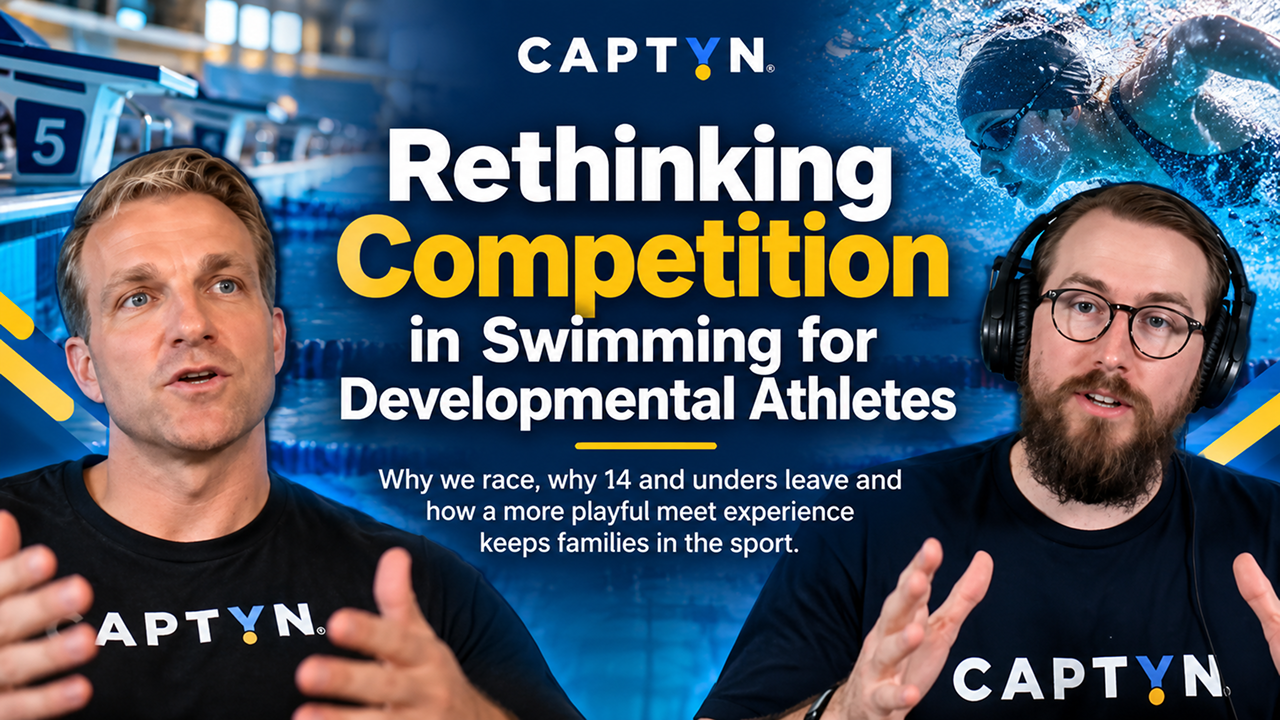
In a recent Captyn webinar, Chris Bowker and Thomas Meek explored a different way of thinking about competition — one that starts by asking why kids play sports in the first place.
Swimming Is Competing With Every Other Youth Sport
Families don’t evaluate swimming in a vacuum.
They’re choosing between swimming, soccer, basketball, flag football, baseball, gymnastics, dance, volleyball, and countless other activities competing for the same limited time.
And when we look at the developmental versions of many of those sports, something becomes clear: the game is frequently modified to fit the athlete.
Young soccer players compete on smaller fields with fewer players. Youth basketball changes equipment and rules. Flag football can combine a clinic and game into a compact Saturday-morning experience.
Swimming often asks young athletes to participate in essentially the same competitive structure they’ll encounter at much higher levels of the sport.
That creates a particularly significant challenge for families.
A traditional swim meet can consume three or four hours — sometimes much more — while a young swimmer may spend only a few minutes actually racing. Compare that with a developmental soccer or basketball game where athletes may be actively involved throughout most of a roughly hour-long competition.
Swimming’s problem isn’t necessarily competition.
It’s the ratio of waiting to playing.
The Missing Ingredient: The Shared Experience
There’s another major difference between swimming and many team sports.
Imagine a basketball game.
Whether a player is having a great individual performance or a terrible one, the outcome doesn’t rest entirely on that athlete. They can pass, defend, screen, rebound, encourage teammates, and contribute in different ways. Their team can still win even when they personally aren’t playing their best.
Swimming doesn’t usually provide that same flexibility.
A swimmer steps onto the block and attempts to do something incredibly difficult: perform better than they ever have before.
If they swim a best time, the meet feels successful.
If they don’t, it can feel like failure.
Now repeat that experience meet after meet.
Swimming teaches extraordinary lessons about personal responsibility, hard work and delayed gratification. Those qualities shouldn’t disappear. But they don’t have to come at the expense of play, camaraderie and shared achievement.
That’s especially important when we consider why people enjoy games in the first place.
Most People Play Games to Be With Other People
One framework discussed during the webinar is Richard Bartle’s Taxonomy of Player Types.
Bartle grouped players into four broad motivational categories:
Achievers enjoy progress, rankings, points and personal records.
Explorers enjoy discovery, experimentation and understanding how a system works.
Killers are motivated by directly competing against and outperforming others.
Socializers play primarily to connect, collaborate and share an experience with other people.
The framework provides an interesting lens through which to look at swimming.
Traditional swimming does an exceptional job serving achievers. Times, cuts, rankings and personal records provide constant measures of progression. It also provides clear opportunities for highly competitive athletes.
But what does the traditional meet provide for the swimmer who primarily wants to be part of something?
If young athletes value shared experiences, then competition itself represents an opportunity to create more of them.
Not Every Meet Has to Serve the Same Purpose
The answer isn’t getting rid of traditional swim meets.
Championship-style competition serves an important purpose. For older and highly competitive athletes, prelims/finals meets, qualifying standards and championship environments can provide exactly the experience they’re looking for.
The mistake is assuming every competition needs to look like that.
Instead, coaches can think of competition as a spectrum ranging from serious competition to pure play.
Different formats can serve different athletes, different points in the season and different developmental objectives.
That gives teams an entire menu of possibilities.
Block Parties, Intersquads and Dual Meets
Some of the easiest changes don’t require reinventing swimming at all.
Short Block Parties, intersquad competitions and dual meets can give swimmers real racing opportunities without requiring an entire weekend.
Teams can experiment with scoring every heat, creating team competitions, running time trials during normal practice hours, or designing meets around specific objectives.
A coach could even build a practice around an official racing opportunity.
Instead of simply completing another distance set, for example, swimmers could race an age-appropriate distance for an official time and then build the rest of the practice around that performance.
Competition becomes part of training rather than an additional burden placed on the family’s schedule.
Turn Swimming Into a Team Game
Team-based match formats offer another possibility.
In a Swim League match, small teams of swimmers compete through multiple rounds. Events can be revealed during the competition, forcing each team to decide which swimmer should race each event.
Suddenly, swimmers aren’t just asking:
“How fast can I swim?”
They’re asking:
“What does my team need from me?”
There is strategy. There is uncertainty. There are teammates depending on one another. A swimmer can have an imperfect race while still contributing to a winning team.
Those are fundamental components of other team sports that swimming can incorporate without changing the fundamental act of racing.
Relay Meets: Make Everything Shared
Relay competitions offer perhaps the simplest way to transform swimming into a shared experience.
Every performance contributes directly to a group result.
A developing swimmer doesn’t have to see their name sitting at the bottom of an individual results sheet. Instead, they can contribute one leg to a relay that accomplishes something together.
Teams can build entire competitions around traditional relays, creative relays or infinity relays. They can even incorporate them into Swim-a-thons or team-building events.
The times don’t always need to matter.
Sometimes the purpose of racing can simply be racing.
Create Competitions That Reward Different Types of Athletes
Swimming can also borrow concepts from other sports.
A multi-sport competition could combine swimming with running, strength challenges or obstacle-style events.
A swimming combine could test skills such as vertical kicking, broad jumps, medicine-ball throws, underwater distance, starts or short sprints.
A King & Queen of the Pool competition could reward versatility across multiple events rather than specialization in one.
Each format changes what success looks like.
And that’s important.
A swimmer who isn’t currently the fastest athlete in their group may discover they’re exceptional at something else. Giving them an opportunity to contribute and succeed can strengthen their connection to the sport while they’re still developing.
Variety Is a Retention Strategy
The larger point isn’t that coaches need to select one new meet format and abandon everything else.
It’s almost the opposite.
Build variety into the season.
There should still be serious meets. There should still be opportunities to chase cuts, qualify for championships and test whether months of training produced faster swimming.
But those experiences can coexist with dual meets, relays, team matches, Block Parties, combines, multi-sport events and competitions built primarily around fun.
For developmental athletes, especially, competition should help create the reason they want to continue training.
A swimmer who stays in the sport long enough will eventually have plenty of opportunities for serious competition.
First, we have to make sure they stay.
And sometimes the best measure of a successful swim meet isn’t the number on the clock.
It’s how many kids leave the pool excited to come back.

More Ways to Explore Captyn

Demo
See Captyn in action by exploring top features and watching a free demo of the platform

Success Stories
See how organizations of all sizes are operating and growing their businesses on Captyn

Live Events
Meet up and chat with us at one of the many live events we sponsor and attend all across the country