%20-%20All%20Logos_Primary%20-%20Full%20Color.png)
The Case for Seasonal Swimming: Retention, Performance, and a Better Business Model



Intro
On this episode of the Business of Swimming Podcast, the conversation with Bobby Guntoro started with a simple but important question he raised in an Instagram post: why is there so much pushback against designing age group swimming as a seasonal sport instead of requiring year-round or nearly year-round participation?
From that post, we opened up a bigger discussion about whether planned breaks, smarter periodization, and more flexible commitment levels could help young athletes stay engaged longer, reduce burnout, and create a stronger foundation for competitive swimming. What started as a conversation about 12-and-under training quickly became a broader look at long-term athlete development, retention, multi-sport participation, and the business case for building swim programs that keep more kids in the water without asking them to specialize too early.
Link to Bobby’s instagram post
The Problem We Are All Trying to Solve
For Bobby, the push toward seasonal swimming is not just a theory. It comes from what he has seen on deck, in the college environment, and in the Wilmington swimming community.
Early in his time back at UNCW, a longtime athletic trainer said something that stuck with him:
“Swimming is a really interesting sport. It’s the sport where the athletes themselves hate the sport.”
Bobby’s reaction was simple: “Well, that’s wrong.”
The concern was not that college athletes were tired after a hard practice or a long season. It was that many of them were arriving at the college level already mentally worn down by the sport before they ever took a stroke for UNCW.
That observation pushed Bobby to look further down the pipeline. If swimmers are showing up at 18 already burned out, the problem likely starts much earlier. So he began auditing swimming participation in Wilmington, especially summer league swimming.
What he found was a familiar pattern: participation is strong in the younger age groups, especially around ages 7 and 8, remains solid at 9 and 10, and then takes a major hit at 11 and 12.
As Bobby put it:
“Guess where the big drop is? 11 and 12. A massive drop.”
That age matters. Around 11 and 12, kids are entering middle school, trying school sports, joining soccer, basketball, volleyball, baseball, or other activities, and gaining more control over what they enjoy. At the same time, traditional swimming often asks families to move in the opposite direction: more months, more practices, more meets, and more financial commitment.
For many kids and parents, that is where swimming stops fitting into their lives.
Research on swimming participation has also identified significant attrition as swimmers move through adolescence, with differences in retention by age and gender. The exact estimates vary depending on the population and methodology studied, but the broader trend is clear: swimming loses a substantial percentage of its athletes before they ever reach the senior levels of the sport.
That is the problem Bobby is trying to solve in Wilmington, and it is a problem most clubs face.
Not how to get more 10-year-olds to swim AAAA times. Not how to make every 12-and-under athlete develop a huge aerobic engine.
The bigger question is how to keep more young athletes connected to the water long enough to still love swimming at 13, 14, 15, and beyond.
Why Retention Matters for Developing Faster Swimmers
If the competitive goal of a club team is to develop as many fast swimmers as possible, then getting more athletes to the 15-and-over age group should be one of its highest priorities.
A useful study supporting this argument is “Large N: A Strategy for Improving Regional Sport Performance” by Andrew C. Cornett and Joel M. Stager. The researchers looked at USA Swimming Age Group Detail reports across 59 Local Swimming Committees and compared participation numbers with the fastest 50-yard freestyle performances by age and gender.
Their conclusion was simple but powerful: the more swimmers a region had, the faster its top performances tended to be.
The number of swimmers was a significant predictor of the best performance in every age, gender, and year combination studied, explaining an average of 41% of the variance in fastest times and as much as 62% in some cases.[1]
The implication for swim teams is compelling: maintaining a larger pool of athletes gives a program more opportunities to develop high-level senior swimmers, stronger relays, and higher-performing teams.
Increasing participation and retention is not just good for revenue or community engagement. It can also be part of a competitive strategy. If more kids remain connected to swimming through ages 12, 13, and beyond, programs maintain a larger pool of athletes from which their future senior swimmers can emerge.
In other words, retention and performance do not have to be competing goals. A bigger, healthier base of young swimmers creates a stronger competitive ceiling later.
We have already seen this philosophy play out in Georgia. In our Business of Swimming talk with Ian Goss of Stingray Swimming, Ian discussed how reducing the commitment expected of younger swimmers—including limiting travel-meet participation—helped keep more athletes in the sport long enough to reach senior-level LSC championships and ultimately continue swimming in college.
How Seasonal Swimming Can Retain More Talented Athletes
One of the biggest benefits of Bobby’s seasonal model is that it gives swimming a way to stay in an athlete’s life without forcing that athlete to choose swimming over everything else too early.
There is a growing body of research supporting the benefits of delayed specialization in youth sports, including swimming. Instead of asking every talented 9-, 10-, or 11-year-old to commit to a traditional year-round schedule, Bobby has built options that allow kids to swim once a week, twice a week, or more depending on the season, their goals, and what else is happening in their lives.
That flexibility matters because some of the best young athletes are not only swimmers. They are soccer players, surfers, basketball players, volleyball players, and kids who are still figuring out what they love.
Bobby mentioned a 12-year-old boy in Wilmington who is a strong swimmer but also competes in surfing. Without a more flexible swim option, his family told Bobby he likely would not be swimming anymore. Instead, because there was a program that fit around his life, he stayed connected to the sport.
Bobby also talked about young girls in his program who are strong soccer players. In the past, families like theirs might have skipped swimming entirely during the school year because soccer already filled Monday, Tuesday, and Thursday. But when Bobby offered a once-a-week option, those families had a way to keep swimming in the rotation.
As he explained, parents responded with:
“Whoa, you guys are offering once a week. Absolutely. Now we’re going swimming also.”
That is the real power of seasonal swimming.
It does not lower the bar for serious swimmers. It creates more entry points for athletic kids who may eventually become serious swimmers if the sport gives them enough room to grow into it.
A 10-year-old soccer player who swims once a week is still learning skills, building confidence, developing friendships, and staying part of the swimming ecosystem. Without that option, that same athlete may disappear from the sport completely.
For Bobby, the goal is not to make every 12-and-under athlete train less. The goal is to keep more athletes engaged long enough to have a choice.
If swimming can play well with other sports when kids are young, more of those kids may still be around at 13, 14, and 15 when they are ready to commit at a higher level. Seasonal swimming helps preserve that possibility.
Training Seasonal Athletes With the Ryan Held Methodology
A common objection to seasonal swimming is that athletes will fall behind if they are not in the water year-round.
Bobby’s experience at NC State challenges the assumption that more time in the water automatically produces better development. For him, the question is not simply how often an athlete trains, but what they are actually accomplishing when they train.
He shared the example of Ryan Held, who was coming off his senior year at NC State mentally worn down. Bobby and the staff recognized that before they could get the best out of him physically, they had to help him rebuild his relationship with the sport.
So they changed the model.
Instead of piling on more pool time, they limited his time in the water.
That fall, Ryan was swimming only about three days a week for much of the training cycle. There was no traditional warm-up, no traditional warm-down, and very little filler. The work was highly specific: speed, power, resistance, overspeed, and intentional race-focused training.
At the same time, he spent more time developing strength in the weight room. As Bobby explained, the goal was to cut out the “garbage yardage” and make every repetition matter.
The result was not a step backward. Ryan went on to break the American record in the 100 freestyle in SCM.
Of course, an elite, fully developed swimmer and a developing 10-year-old are not physiologically or technically comparable. Bobby’s takeaway was not that age group swimmers should copy Ryan Held’s training schedule.
The lesson was that more training is not automatically better training, and that intentionality, technique, and athlete engagement matter.
For Bobby, that experience became a turning point in how he thought about training younger athletes too. If purposeful training could be so important at the elite level, perhaps age group development should also focus less on accumulating repetitions for their own sake and more on developing great habits.
That idea carries directly into how Bobby thinks about seasonal athletes.
With young swimmers, he is not trying to build fitness by asking them to repeat average strokes over and over again. He is trying to build great habits before bad ones become permanent. As he put it, swimmers are always developing either “good habits or bad habits.” There is not much in between.
For a 10-, 11-, or 12-year-old, that means the goal is not simply to survive long sets while technique falls apart. The goal is to learn how to move well in the water, understand the language of the sport, and swim fast with good mechanics.
Bobby would rather see a young athlete execute short, focused work with great technique than grind through yardage that teaches them to swim tired, sloppy, and disengaged.
That is the heart of training seasonal swimmers.
Less time in the water does not have to mean less development. If the program is designed well, seasonal swimming can create athletes who are fresher, more engaged, more athletic, and more technically sound when they do show up.
The emphasis shifts from attendance as the measure of commitment to intention as the measure of progress.
An aerobic engine can be developed over time. Undoing poor technique ingrained through hundreds of thousands of repetitions can be much harder.
Redesigning the Competitive Calendar Around Performance and Mental Health
Bobby’s view of seasonality is not about lowering expectations. It is about aligning the calendar with how athletes actually develop, recover, and stay motivated.
Instead of stretching short course swimming into one long grind from fall through spring, a healthier model could break the year into clearer seasons: a fall short course season that ends with a December championship, a spring short course yards season, and a summer long course season.
For 12-and-under swimmers, that structure creates natural reset points, gives families and coaches real breaks, and allows athletes to come back with more energy and purpose.
Less competitive swimmers could also stay engaged through more local, lower-pressure opportunities like Block Party-style meets (learn more about Block Party meets in our talk with Julie Bachman), short sessions, and fun community competitions that do not require full-season commitment.
In Bobby’s mind, coaches are already skilled at helping athletes peak when the calendar tells them to. The bigger opportunity is to build a calendar that gives them better peaks to aim for while protecting athlete mental health, reducing burnout, and keeping more kids in the sport long enough to reach their best years.
The broader conversation around athlete mental health should also push age group programs to consider the role they can play in creating healthier relationships with the sport from an early age.
Planning for the “Time Off” in Seasonal Swimming
One of the first questions coaches ask about seasonal swimming is practical: if athletes are taking planned breaks, how do coaches still get paid?
It is a fair question. Seasonal swimming only works if the model is sustainable for the business and for the people coaching it.
The answer is not to leave coaches idle or let pool space sit empty. The answer is to plan the “off” parts of the season with the same intention as the competitive training blocks.
In many cases, seasonal and recreational programming can generate enough revenue per lane hour to support coaching pay on its own. But the opportunity goes further than that.
When a training group moves into a lower-commitment phase, teams can use that space and staff time for offerings that are easier to schedule, easier to sell, and often more profitable.
Private lessons are one of the clearest examples. In the Business of Swimming conversation with Patrick Park, the lesson was that private lessons are not just extra income. They can become a real business line for coaches and organizations when scheduled intentionally, priced appropriately, and marketed to the right audience.
Patrick found strong demand not only from age group swimmers, but also from adult athletes, especially triathletes and Masters swimmers who were willing to invest in technical improvement.
That same logic applies during lower-commitment swim seasons. Coaches can open lesson blocks before or after practice, on weekends, or during seasonal breaks.
Teams can also run one-day clinics around stroke technique, starts and turns, speed and power, underwater work, race skills, or triathlon swimming. These offerings give coaches paid hours while giving families and athletes flexible, high-value ways to stay connected to the program.
And sometimes, the best use of the off period is not another product at all.
Sometimes coaches should actually take a vacation.
One of Bobby’s strongest points in the conversation was that seasonal swimming can create healthier rhythms not only for athletes, but also for coaches. A model that gives families a break, gives athletes a reset, and gives coaches time away from the deck may be better for everyone involved.
That is the key.
Seasonal swimming should not mean empty lanes, lost revenue, or unpaid coaches. Done well, it means a smarter calendar.
Competitive blocks can be surrounded by lessons, clinics, adult programs, triathlon offerings, administrative work, and real recovery time for staff.
The goal is not to do less business. The goal is to build a business that does not depend on burning out athletes, families, or coaches to survive.
The Business Case for Seasonal Swimming
The competitive case for seasonal swimming is about retention. The business case may be just as compelling.
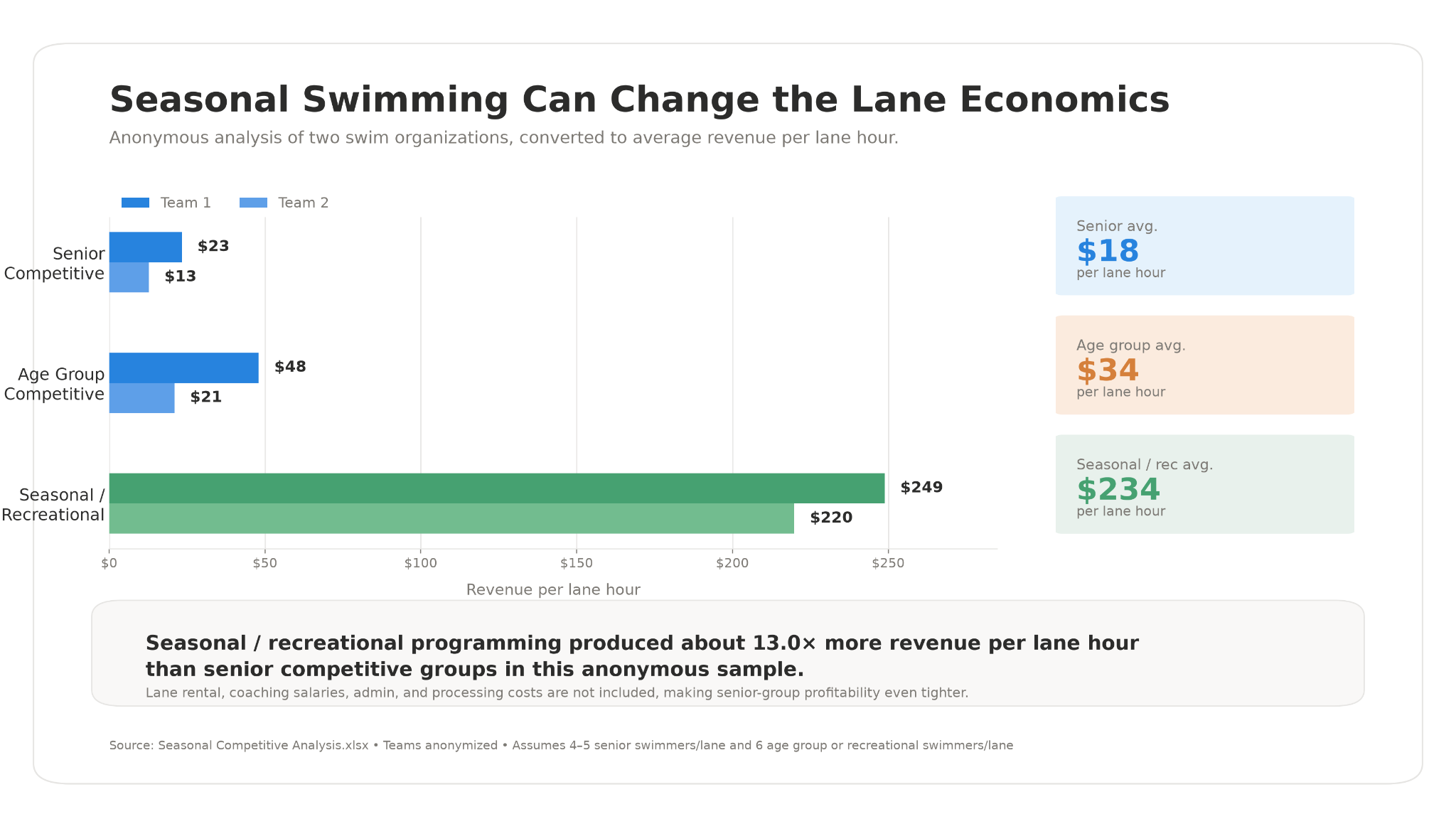
In a simple analysis of two swim organizations with a healthy mix of senior, age group, and seasonal programming, the difference in revenue per lane hour was significant.
Senior competitive groups produced the lowest revenue per lane hour, while recreational and seasonal programs produced the highest. Across the two examples, senior groups generated roughly $13 to $23 per lane hour, age group programs generated roughly $21 to $48 per lane hour, and recreational or seasonal programs generated roughly $220 to $249 per lane hour.
For this analysis, revenue per lane hour is calculated by dividing program revenue by the total lane hours consumed by the program. These figures represent revenue rather than profit and do not account for each organization’s individual expenses, including coaching payroll, lane rental, administrative overhead, equipment, or other operating costs.
Those numbers matter because lane space is one of the most important constraints in aquatics.
Every program has to decide how to use its water, and every hour in a lane has an opportunity cost. If a senior group is putting four or five athletes in a lane for a long practice, the revenue generated per lane hour can be relatively low.
Once a team’s actual lane-rental costs, coaching payroll, and other expenses are factored in, the economics of those groups can become even tighter.
That does not mean senior swimming is not valuable.
Senior groups create the top of the pyramid. They build team identity, produce championship swimmers, inspire younger athletes, and give a program its competitive purpose.
But from a business standpoint, the top of the pyramid is often supported by the base.
Seasonal swimming, recreational swimming, clinics, lessons, and other flexible programs can generate more revenue from the same water while also bringing more families into the organization.
These programs are not just “extra” offerings. They can be the financial engine that allows a team to pay coaches, use water more efficiently, and support the competitive pathway long term.
That is what makes Bobby’s model so interesting.
Seasonal swimming is not simply a softer alternative to year-round training. It can be a smarter business model. It gives families more accessible entry points, keeps more kids connected to the sport, and helps programs turn limited lane space into greater revenue and, ultimately, stronger profitability.
Bobby Guntoro’s Vision for Age Group Swimming
Bobby Guntoro brings a rare perspective to the conversation about age group swimming.
As the head coach at UNC Wilmington, a former UNCW swimmer, an international competitor for Indonesia, and a coach who helped build elite success at NC State, Bobby understands what it takes to perform at the highest levels of the sport.
But his view of swimming goes beyond medals and championship meets.
Through programs like AquaHawks and Wilmington Swim Academy, he is focused on building a healthier, more sustainable pathway for young swimmers—one that keeps more kids engaged, helps them develop strong fundamentals, and gives them the chance to still love the sport when they reach their teenage years.
The Bigger Question for Age Group Swimming
The takeaway from Bobby’s argument is not that every swim team should abandon year-round swimming.
It is that year-round swimming does not have to be the only pathway.
That distinction is important.
You can still have highly committed athletes training at a high level. You can still develop national-caliber swimmers. You can still have senior groups chasing championships.
But underneath that pathway, clubs can create seasonal, once-a-week, twice-a-week, recreational, and multi-sport options that allow more children to remain swimmers.
Instead of asking whether a 10-year-old is committed enough to swimming, perhaps the better question is whether swimming is flexible enough to remain part of that 10-year-old’s life.
Because the 10-year-old who plays soccer and swims once a week today may become the 15-year-old who decides swimming is the sport they love.
The only way to find out is to keep them in the water long enough to make that choice.
And if doing that keeps more athletes in the sport, creates a larger senior swimming population, uses lane space more efficiently, creates additional revenue opportunities, and gives coaches and families healthier breaks throughout the year, then seasonal swimming is not necessarily a compromise.
It may simply be a better-designed pathway.
More Ways to Explore Captyn

Demo
See Captyn in action by exploring top features and watching a free demo of the platform

Success Stories
See how organizations of all sizes are operating and growing their businesses on Captyn

Live Events
Meet up and chat with us at one of the many live events we sponsor and attend all across the country