%20-%20All%20Logos_Primary%20-%20Full%20Color.png)
Building Swim Experiences Parents Want to Buy

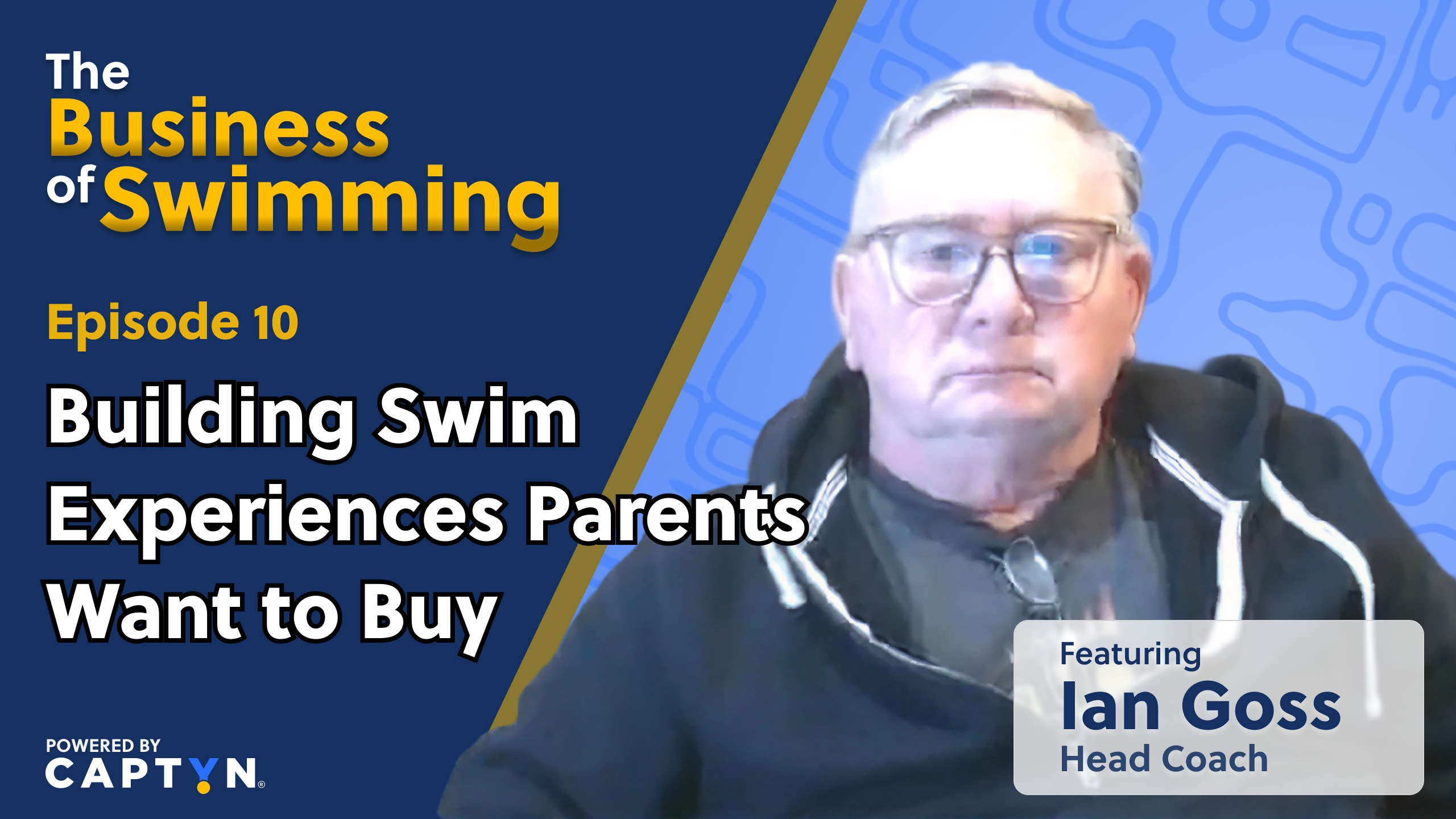


When you build your age group program to meet parents’ and athletes’ needs (and not the club’s competitive desires), parents and athletes will still be there at the senior level.
The Business of Swimming Podcast received a master class on segmenting your programming based on commitment and desire for the sport to increase participation and profits. How Ian Goss from Stingrays Swimming nailed the local swim model (rec-league). Their LAPS program is competing with soccer, basketball, volleyball, and flag football so youth athletes can be multi-sport and grow their love for swimming simultaneously.
The opportunity Ian saw was the other 90% of the swim market.
There are an estimated 3 to 4 million summer league swimmers in the United States, and each year less than 10% ever make it to USA Swimming. Conservatively, more than 30% of those swimmers swim for less than three years. We all already know this, but don’t internalize that traditional competitive USA Swimming is not for low-income families, the multi-sport athlete, or the busy family. It is all-consuming, as it needs to be in order to produce top-level athletes on the world stage.
But why are we forcing parents and young athletes into a travel-ball model where they are spending more time and money on meets than monthly dues?
A few teams are attacking this problem head-on with a new product: a low-commitment, fun, skill-development program that starts to capture the other 90% of active competitive swimmers. They aren’t just offering the high-octane Porsche and Audi models; they’re creating a family-friendly Volkswagen product. Ninety percent is a big market segment to ignore. Stingrays is proving summer leaguers want to swim more than just the summer if you offer a product that fits their needs. Otherwise, they buy soccer, basketball, or other activity-based experiences.
This is exactly what Ian Goss described when he talked about how parents react to the traditional pitch:
“Nowadays you tell the parent that yes, we’re a year-round program and their eyes get big like we don’t want to sign up for a whole year. You’ve got to be aware of your surroundings and your community, what does the community need, but also within your philosophy and your mission of your program.”
The Stingrays Swimming Age Group Structure
The first step in creating this model is acknowledging that any 10-and-under success has zero indication of senior success. In fact, there is an inverse correlation between young stars turning into senior, collegiate, or professional stars.
Ian and the coaching staff made the decision to remove championship competition from their 10-and-under age group from their team entirely. Yes, they went to Georgia LSC Championships without ⅓ of their scoring potential.
The backbone of that decision came from their internal retention data:
“We did a study… we used to take 10 and unders to the state meet… And we did a study that only about 15 to 20 percent of GA Swimming kids actually make it to the senior state… So there’s… about 80 percent of the kids don’t make it to that level. We treat them like little… senior swimmers.”
And yes, there was pushback from parents of young rising stars:
“We did get a little bit of backlash… We did have a few people leave. No lie there.”
But Ian stayed committed, educated parents, and rebuilt the product.
Next, they worked with their parents and, through trial, learning, and change, built a product that over 400 families a year purchase (multiple times). Here are the details of the Learn, Achieve, Play, Swim (LAPS) program.
The customer: the other 3,500,000+ families
- Swimmers typically in elementary or middle school (high school prep is included)
- Athletes who participate in multiple sports or activities
- Parents are not ready for a long-term commitment to a sport
- Busy and ever-changing family schedules
This shows up clearly in how Ian explains the “come and go” reality and why it’s actually a feature, not a bug:
“They’ll spend six weeks with us maybe two sessions and then they’ll go play basketball or gymnastics… and then they’ll come back…We actually encourage them to do that… We strongly encourage them to do other things because they come back as a better athlete, and usually a friend or two.”
The LAPS program
- Elementary: 7–11 years old. Swim 1–3x per week at 45–60 minutes per practice.
- Middle school: 11–14 years old. Swim 2–4x per week at 60–75 minutes per practice.
- Duration: 6-week sessions that include competitions
A key here is flexibility for the family. Families pick days of the week they want to swim, ranging in how many days based on age. With a 6-week session, they can commit to certain days that align with other activities and sports. As seasons change, they can change those days, or leave and come back, fitting the experience into the life of the family, not asking the family to fit into the traditional swim model.
Ian is direct about why six weeks works:
“Our slogan is give us six weeks and we do six week sessions… throughout the whole year I think we do seven or eight sessions. We tried to go nine weeks but we find six weeks is a nice… it works well…”
And it’s not “random practices.” It’s structured progression:
“They each have 10 to 20 different skills they gotta learn and once they learn those… they move on to the next group…”
Competition (without the travel-ball burden)
Ian also explains how they use bite-sized competition to train families and keep things fun:
“They have a separate thing for themselves after each session. And we have a theme… Halloween, Thanksgiving, Christmas. It’s just one day and lasts under two hours.”
He also makes the case for what they don’t do:
“We don’t expose them to a three day, four day meet, sitting in the stands for three or four hours to watch your kids swim a 50 and then go home. To us, that’s just not fun.”
Lane management (why this works operationally)
This program is highly effective in lane management. For a typical competitive group of any age, you have roughly 6 practices at 2 hours a week, which is a 12 hours training block of lane space. You can still only fit 4 to 6 athletes in that lane for the 12 hour training block.
For the LAPS program, in that same lane for a 12 hour training block here is how the numbers would shake out.
- An athlete practices on average 2 times per
- Each practice is on average 1 hour long so you can effectively run 12 practices.
Keeping with the 4-6 kids per lane per practice, can effective 4-5x the number of participants. For 12 hours of a single lane space you have at least 24-30 potential athletes that can now participate. This is because the athletes practice is half as long and they participate in ⅓ to ½ the number of practices each week.
Now you multiply by the dollars paid, and I think you will see the business case for a LAPS program.
The LAPS staffing blueprint
A session-based program only works when it feels consistent and friendly every single day. That consistency is not about hiring “elite” coaches with stacked resumes. It is about hiring for connection, then building a system that makes great delivery repeatable so the experience feels the same whether it is Monday or Thursday, week one or week six, your best coach on deck or your newest.
1) Hire for energy and approachability first
If you are building a program for elementary and middle school families, the “product” is not just the swim instruction. It is the way the program makes kids feel safe when they walk onto the deck, and the way parents feel when they have a question.
That means your best hires are usually the people who:
- genuinely like being around kids
- communicate naturally with parents
- can run a group with calm authority
- bring a “welcome” vibe to the deck
Stroke knowledge matters, but warmth and presence are harder to teach. You can train mechanics and progressions. You cannot easily train someone to be approachable, encouraging, and consistent day after day.
2) Train with written practice plans (non-negotiable)
If you want the program to scale, you cannot rely on improvisation. The goal is repeatability across staff and sites, which means every practice needs a plan that is easy to follow and easy to execute.
A strong session-based plan typically includes:
- dryland WUTS (Warm Up to Swim - GAIN) plus a game
- a warm-up skill focus (what we are teaching today)
- a main set that follows a progression (what we are building)
- a game or relay element (how we keep it fun and social)
- a wrap-up with a quick recap (what swimmers achieved today)
Written plans reduce variability and prevent “winging it,” which is where quality drops and parent confidence gets shaky, especially when staffing changes or subs step in.
3) Use senior athletes as assistants (culture + pipeline)
One of the smartest ways to strengthen a session program is to connect it to your older swimmers. Senior athletes can be incredible with younger swimmers when you give them clear roles and expectations.
The key is positioning. Senior athletes are lane assistants, not “head coaches.” Their job is to:
- encourage swimmers and demo skills
- help with equipment and organization
- model team culture and standards
- Be a role model that inspires young athletes to do more
The benefits stack up fast. Young swimmers look up to them. Senior athletes learn leadership. And the whole program starts to feel like one connected team, where entry-level swimmers can picture themselves becoming the older athletes they see on deck.
The benefits to the competitive team - 30 active college swimmers.
Let’s start where it matters most to most competitive coaching staffs: performance. When you can boast over 30 active college swimmers that requires a team not only to produce fast swimmers but fast swimmers who love the sport. With simple math Stingray is graduating 7 to 8 athletes a year that will swim in college.
You could argue that Stingrays is a top performer for a team their size. They take almost double the number of athletes to Senior Champs as Age Group Champs, even though the age range is exactly the same for their team (four years).
The senior team also boasts more than 75 athletes across three USA Swimming competitive groups, while the age group team is just over 100 athletes. They consistently have Junior National and, Trials qualifiers. Stingrays has won Senior Champs in the highly competitive Georgia LSC. They have had national record holders, NCAA champions, and athletes compete for TEAM USA.
Ian’s explanation for why swimmers stay engaged long enough to reach that level is simple: the program has to keep giving swimmers something to aim at incrementally.
“We do that incrementally. So there’s always something better, something they can look forward to. I think that’s extremely important.”
“We don’t treat everybody the same. But we treat everybody equally.”
The retention rate
Their retention of swimmers is better because they have more opportunities for athletes to stay in the sport in a meaningful way.
Ian talks about how a LAPS swimmers at 12 routinely ends up on the A relay at 18. The athlete that is really athletic and plays a lot of different sports isn’t having to choose at a younger age, and has a chance to develop their athleticism.
Ian also describes the “place for every kind of swimmer” approach, without obsessing over attendance as the measure of commitment:
“We have places for pretty much any kind of athlete…We don’t take attendance… it’s not a big pressure thing.”
It’s the coaching staff’s job to help the athlete fall in love with swimming without all the pressure of commitment and performance at a young age. The LAPS program provides a place for those athletes to stick with swimming, develop into great athletes, and in turn become great swimmers.
And when a coach does see a swimmer with the potential for the next level, Ian frames it as an obligation to communicate, not pressure:
“If we see… talent, we sit down with mum and dad and talk to them about it… If you’re a coach and you see that, you have an obligation to let them know that… But it’s still left up to them, there’s no pressure…”
About Ian Goss and Stingray Swimming -
Ian Goss has been a cornerstone of Stingrays Swimming since 1990, bringing decades of leadership and athlete development to the communities just north of Atlanta in Cherokee and Cobb counties. As head coach, Ian has helped build a program known for “Training 4 Life” and a culture grounded in discipline, dedication, and long-term growth.
A constant innovator, Ian was the first client of SERG to cover a season pool, an approach that has helped teams across the Southeastern U.S. protect water access and keep their seasons on track. With a track record that spans athletes’ success from age-group development through international achievement, Ian continues to push the sport forward, making him a natural fit to for the Business of Swimming Podcast.
More Ways to Explore Captyn

Demo
See Captyn in action by exploring top features and watching a free demo of the platform

Success Stories
See how organizations of all sizes are operating and growing their businesses on Captyn

Live Events
Meet up and chat with us at one of the many live events we sponsor and attend all across the country