
$1.6M+ in Revenue in 6-Lane Pool : How West Coast Aquatics Does It.


Most swim teams think their biggest constraint is the number of swimmers they can attract.
West Coast Aquatics, a board-run non-profit, shows that the real constraint is something much more specific: lane space.
Operating out of a standard 6-lane, 25-yard pool, West Coast Aquatics has built a model that supports a competitive swim team, a swim school, a recreation team, high school swimming, dryland, masters, and community programming. They have also grown from roughly $600,000 in annual revenue to about $1.6 million, all while supporting six full-time employees with fully paid benefits.[1]
“When I first got here, we were doing about $600,000 a year, and we did $1.6 million last year.”
That would be impressive in a large aquatic center. It is even more impressive in a 6-lane pool.
West Coast Aquatics is also not sacrificing performance to make the business work. They have placed a sophomore boy on the National Junior Team, regularly produce Olympic Trials qualifiers, and continue to build high-level competitive athletes inside a model that is financially sustainable.[1]
So what makes their model different?
They are not sacrificing employee pay, benefits, club financial security, long term investments for the sake of competition. They are using each lane for the right purpose and balance lane usage based on competitive goals and Revenue per Lane-Hour.
Why Revenue Per Lane Hour Matters
Revenue per lane hour is one of the clearest ways to understand the business side of a swim program.
It answers a simple question:
How much revenue does a program generate for each lane it uses per hour?
That matters because every program uses water differently.
A senior training group may need multiple lanes for two hours or more. A swim lesson group may only need a small section of a lane for 30 minutes. A recreation group may serve more swimmers in less time with a lower coaching burden.
If a club only looks at total registration numbers, monthly dues, or roster size, it can miss the bigger picture and the most important metric.
A program with fewer swimmers may be more efficient. A program with more swimmers may be using too much water for too little return. A team may look full, but still be financially stretched because the highest-commitment groups are using the most expensive resource the club has.
At West Coast Aquatics, the numbers make the story clear.
WEST Swim School
$593.51
West Coast Recreation Team
$320.02
West Coast Club
$47.22
The competitive club team is essential to the mission. But from a business standpoint, it is not the strongest revenue producer per lane hour.[2]
The swim school and recreation team are what allow the entire organization to work. Here is a look at every group and the revenue per lane hour.
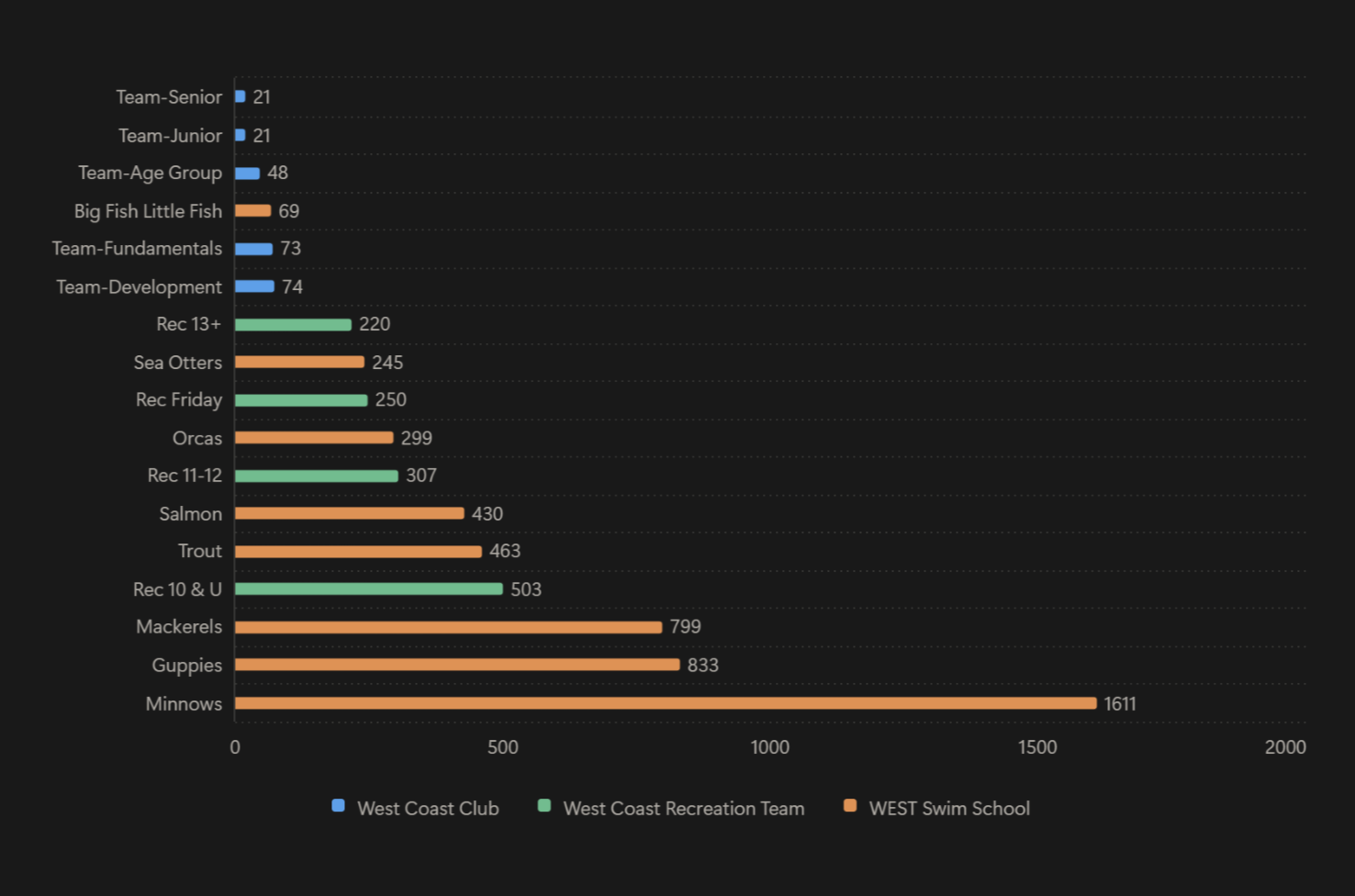
“We’ve crunched numbers and looked at what it would look like if we took away one lane of lessons and gave it to the club team. How many kids would we have to put in the club lanes to make that difference up? You can’t get there.”
The West Coast Aquatics Facility: A Standard Pool With an Unusual Model
West Coast Aquatics is not operating out of a massive aquatic complex.
As Nick Chevalier, President, Head Coach, and General Manager of West Coast Aquatics, described it, the facility is “your standard six lane, twenty five yard pool.” They do not have a separate lesson pool. They do not have unlimited water. They do not have extra lanes sitting unused.[1]
They do own and operate the facility, which gives them flexibility. But that flexibility comes with responsibility. They are financially responsible for the full operation, including staffing, programming, maintenance, and facility costs.[1]
“It’s kind of your standard six-lane, 25-yard pool. We do own and operate the facility, so we have the flexibility to program it out however we want. But the flip side is we are financially responsible for all of it.”
That makes every scheduling decision matter
A traditional club might look at a 6-lane pool and think, “How many competitive swimmers can we fit?”
West Coast Aquatics asks a better question:
What mix of programs creates the best experience for athletes, families, community, coaches, and the business?
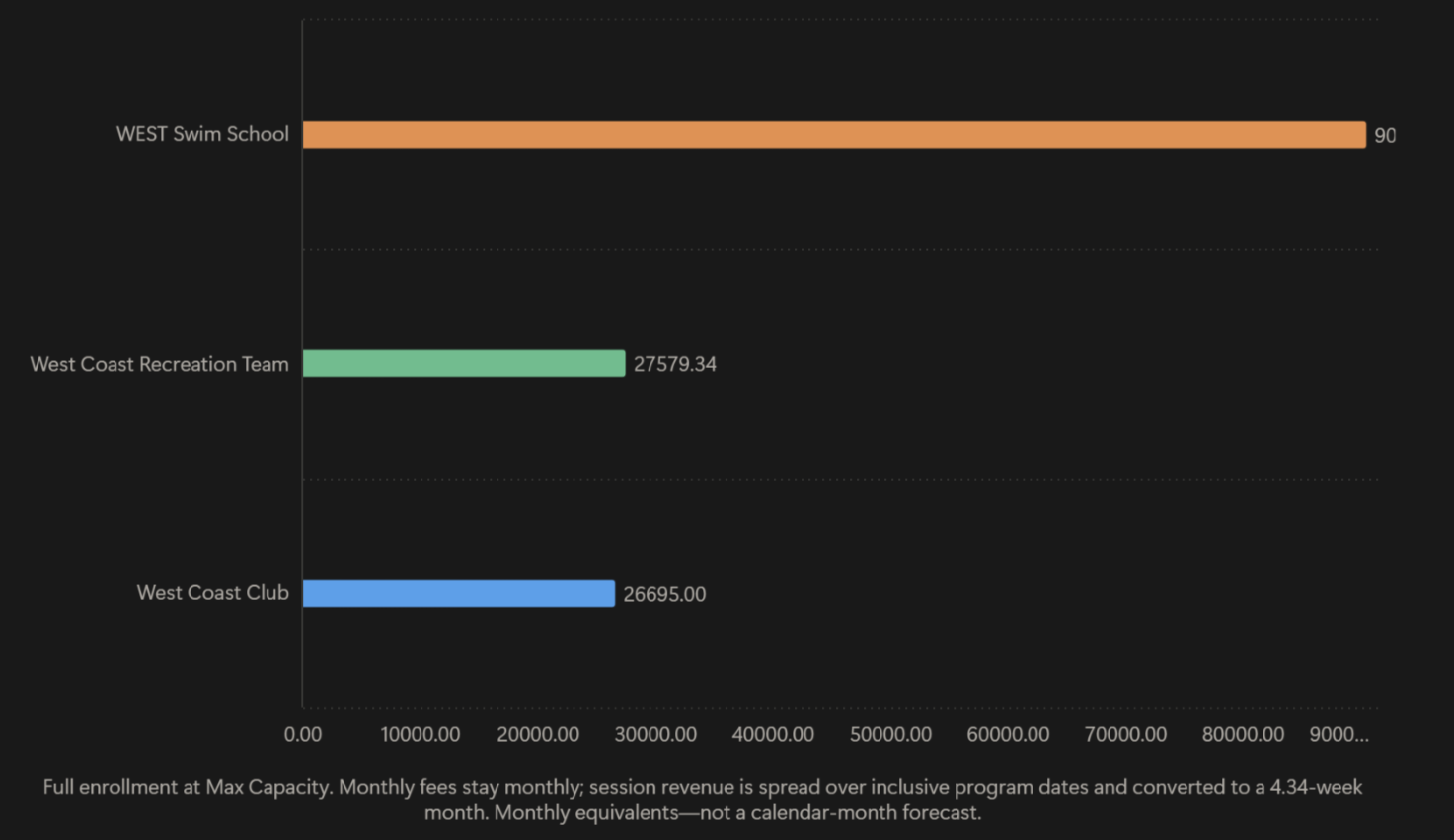
That shift in thinking is the foundation of their model. Here is the distribution of revenue
The Program Mix: Swim School, Rec Team, Club Team, and Community Use
West Coast Aquatics does not rely on one program to carry the organization.
Instead, the pool is programmed across several connected pathways:
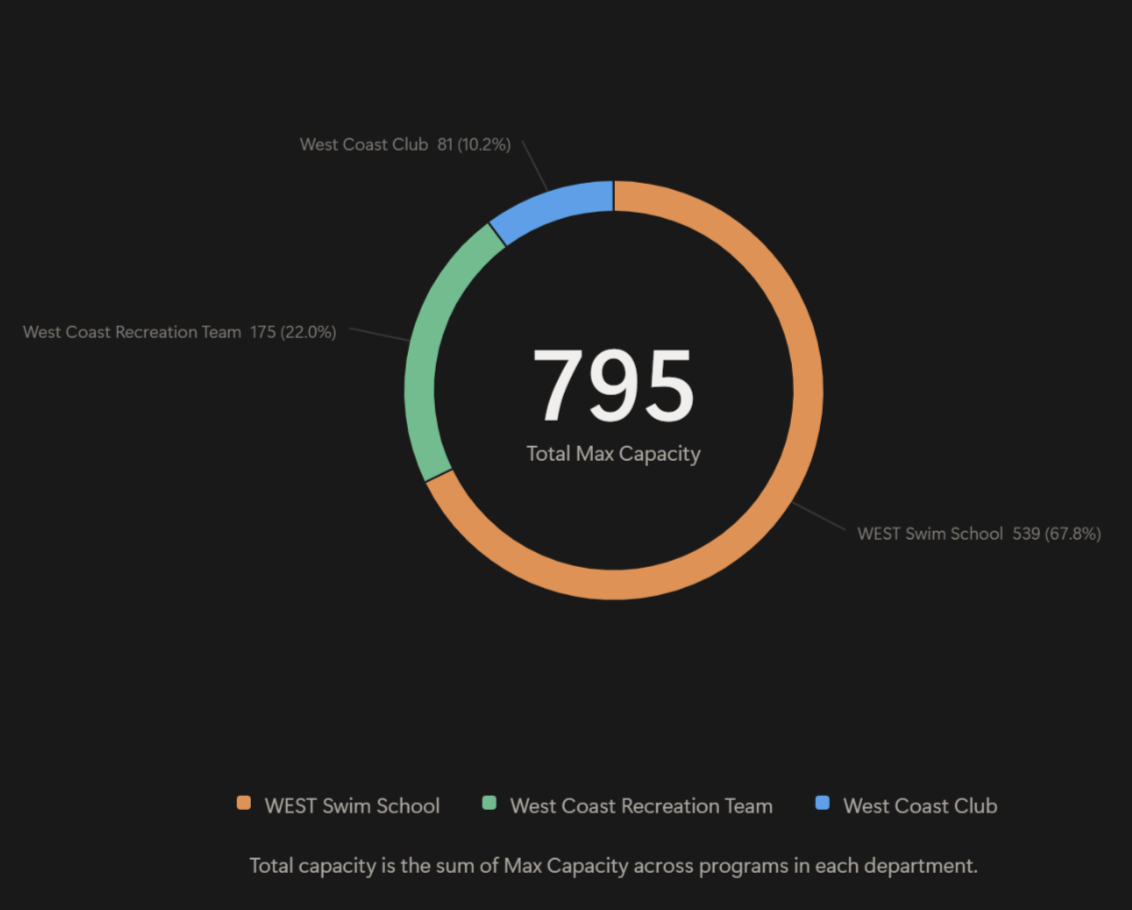
WEST Swim School
The swim school is the largest participation base and the strongest revenue-per-lane-hour driver. It introduces children to the water, creates a steady feeder system, and helps fund the broader organization.
Nick noted that they mostly dedicate two lanes to lessons during prime afternoon hours.[1]
That may sound like a major sacrifice for a competitive team, but the financial return is what makes the model work.
West Coast Recreation Team
The recreation team acts as the bridge between lessons and year-round club swimming.
It gives families a meaningful next step without forcing every swimmer into the highest-commitment track. It also allows athletes to continue swimming while participating in other sports and activities.
West Coast Club
The competitive team is smaller and more selective by design. But because they are able to generate higher margins from other departments, WCA reinvest in the competitive team experiences, coaches, and equipment at a high rate.
Instead of trying to grow the club team endlessly, WCA protects training quality, group culture, and lane space. That smaller structure still produces serious competitive success, including National Junior Team representation and Olympic Trials-level athletes.[1]
Community Programs
WCA also supports high school swimming, water aerobics, masters, and dryland. Some of these programs are not the most profitable use of water, but they strengthen the organization’s role in the community. As a board run non-profit organization community outreach is important when WCA decides to fund raise for facility expansion or a new facility.
That matters.
A swim club is not just a registration engine. It is a community hub.
Lane Space and Capacity: How Each Program Uses the Pool Differently
The strength of West Coast Aquatics’ model becomes clearer when you look at how each program uses lane space, capacity, and weekly training time.
Every program needs water, but not every program uses water the same way.
“You look at how much water a learn-to-swim kid uses for a 30-minute lesson. It’s walls to the flags, and you can fit four or five kids in that space. Whereas your senior kid is using three to four kids in a lane, and they need that lane for two and a half hours.”
A senior group may need multiple full lanes for long practice blocks across the week. A swim lesson group may use only a small section of a lane for short classes. A recreation group can often serve more swimmers with less weekly water time than a traditional club group.
That difference is what makes revenue per lane hour such an important metric.
At WCA, the competitive club team is protected for quality. These groups use the largest lane blocks and the most weekly water time because high-level training requires space, consistency, and coaching attention.
The Revenue Comparison: What the Numbers Reveal
Above is the projected revenue for each department at WCA. The Swim school operates in 2 lanes making over $1M a year. WCA is not over charging, in fact they are charging 30%-50% less than franchise based swim schools in their area.
The competitive club team averages about $47 per lane hour. The recreation team averages about $320 per lane hour. The swim school averages about $594 per lane hour.[2]
That means the recreation team generates roughly 6.8 times the average revenue per lane hour of the club team. The swim school generates roughly 12.6 times the average revenue per lane hour of the club team.
This does not mean the club team is less important. But the club team should be more exclusive to athletes with a certain level of desire, dedication and talent. Creating more homogeneous training groups.
It means the club team needs the right ecosystem around it.
A senior group might use four lanes for two hours. Those athletes are committed, talented, and central to the identity of the club. But they are not necessarily what keeps the business financially healthy.
Nick put it plainly when discussing the tradeoff between lessons and club lanes. WCA has looked at what would happen if they took a lane away from lessons and gave it to the club team. His conclusion was that “you can’t get there” financially.[1]
If you use more of your most limited resources on a low-margin or no-profit programing, you may create more coaching pressure, more lane crowding, and more financial strain.
The better move is to design a program mix where each lane has a job.
Why More Competitive Swimmers Is Not Always the Best Business Decision
One of the most common misconceptions in club swimming is that bigger senior groups are always better.
More athletes means more dues. More dues means more revenue. More revenue means a stronger team.
That sounds logical, but lane economics tells a different story.
Senior swimming is one of the hardest products to make profitable. Older athletes often need more lane space, longer practice times, more coaching attention, more meet support, and more individualized planning.
From a business standpoint, adding more athletes to a low-margin program can actually make the model worse. Instead focusing on right sizing the competitive groups based on facility or lane space constraints. True competitive swimming is more similar to Olympic Development Soccer. Where less than 10% of the soccer population plays at this level because the demands and sacrifice required by athletes and families are so high. Do 50% of swimmers only make it less than 4 years in competitive swimming because they can’t hack it or because we are forcing them into a competitive environment they are not ready for?
That is why WCA’s recreation team is so important.
The rec team gives families another path. It allows swimmers to stay connected to the organization without forcing them into the demands of year-round club swimming. It also allows the club team to remain more focused and selective.
Nick explained that the rec team allows WCA to be “more elite and more restrictive and more qualitative” with the club team because they are not trying to force every swimmer into one mold.[1]
That is a powerful idea.The rec program does not weaken the competitive team. It protects the integrity of the Competitive Team.
Taking Care of Coaches Is Part of the Business Model
One of the most important parts of the West Coast Aquatics story is not just how much revenue they generate.
It is what they do with it.
WCA supports about six full-time employees and provides fully paid benefits for full-time staff. Nick shared that the organization spends about $10,000 per month on medical benefits, including medical, vision, dental, and life insurance.[1]
“We’re spending about $10,000 a month on our medical benefits. We’ve got full medical, vision, dental, life insurance, you name it. We really believe strongly in taking care of people.”
He also explained that employees working more than 24 hours per week are eligible for 50% employer-subsidized coverage, while employees above 35 hours per week are 100% employer covered.[1]
“Anybody above 35 hours is 100% employer covered. We really believe strongly in taking care of people.”
That is rare in club swimming.
Many clubs operating out of a similar pool size might support one or two full-time coaches. WCA has built a model that can support a much deeper staff structure.
That matters because coach turnover is not just an HR problem.
It is a performance problem.
When coaches leave, athletes feel it. Families feel it. Team culture can wobble. Training continuity breaks. Communication changes. Trust has to be rebuilt.
High coach turnover can lead to:
- Lower athlete retention
- Less consistent athlete development
- More parent uncertainty
- Weaker team culture
- More pressure on the remaining staff
- Slower long-term performance gains
A stable coaching staff creates a better environment for athletes.
Coaches who are supported can stay longer, plan better, build deeper relationships, and invest more fully in the program. That consistency compounds over time.
WCA’s model shows that revenue per lane hour is not just a finance metric. It is directly connected to staff sustainability, athlete performance, and long-term team culture.
[Chart Placeholder: How Revenue Supports Coach Retention and Athlete Experience]
The Schedule Strategy: Fitting More Value Into the Same Six Lanes
WCA’s schedule works because it is intentional.
They use dedicated lesson lanes during prime time. They build rec team options around alternating schedules. They layer dryland into the athlete experience. They continue to support high school swimming and community programs.
Nick described the schedule as “a little bit Tetris like,” with each day broken into small increments and different programs layered across pool lanes, dryland space, and time blocks.[1]
That is the reality of running a successful swim business.
The answer is not always to add more lanes. Most teams cannot do that.
The answer is to make better decisions with the lanes they already have.
For WCA, that means asking questions like:
- Which programs need full lanes?
- Which programs can use partial lanes?
- Which programs need long practice blocks?
- Which programs can run in shorter sessions?
- Which programs drive revenue?
- Which programs drive community value?
- Which programs support athlete development?
- Which programs feed the next level?
A strong schedule is not just full.
It is purposeful.
What Other Swim Clubs Can Learn From West Coast Aquatics
West Coast Aquatics is not a copy-and-paste model for every swim team.
Some clubs rent water. Some do not control lessons. Some operate in municipal pools. Some have different community needs, staffing limitations, or facility restrictions.
But every club can learn from how WCA thinks.
Here are the biggest takeaways:
1. Track revenue per lane hour
Do not only look at total revenue or total registration. Understand how much each program produces relative to the water it uses.
2. Build a bridge between lessons and club swimming
A recreation team or pre-competitive program can serve families who are not ready for full club commitment.
3. Do not overload senior groups just to chase dues
More swimmers in a senior group can hurt training quality, group culture, and business performance.
4. Protect the competitive team by giving other swimmers another path
A strong rec program allows the club team to be more focused, more aligned, and more selective.
5. Treat swim school as a strategic program
Swim lessons are not just an entry-level service. They are a revenue driver, a feeder system, and a community need. Lessons will drive the health of your rec-team.
6. Invest in coaches
A better business model should create a better staffing model. When coaches are supported, athletes benefit.
7. Use data to make program decisions
Registration, activities, people management, capacity, and lane usage should all inform how a team builds its schedule.
A Smarter Model for Sustainable Swim Teams
West Coast Aquatics proves that a 6-lane pool can support more than people might think.
But the lesson is not simply that WCA makes more money. The bigger lesson is that they have built a more sustainable model.
They are not trying to turn every swimmer into a year-round club athlete. They are not trying to pack senior lanes until quality drops. They are not treating swim lessons, rec swimming, and club swimming as disconnected programs.
They are building an ecosystem.
Swim school brings families in. Rec swimming keeps more athletes engaged. Club swimming serves the athletes ready for a higher level of commitment. Balancing lane allocation based on competitive goals, financial health, and community service supports coaches, health benefits, re-investment opportunities, and long-term program security.
That is the future more swim teams should be striving for. And for teams that want to make better decisions, the first step is visibility.
When clubs can clearly see registration, activity participation, capacity, revenue, and people management in one connected system, they can stop guessing and start building smarter programs.
Captyn helps swim teams understand and manage the programs that drive their business, from registration and activities to staff, families, and athlete pathways.
Because in a 6-lane pool, every lane/hr matters.


More Ways to Explore Captyn

Demo
See Captyn in action by exploring top features and watching a free demo of the platform

Success Stories
See how organizations of all sizes are operating and growing their businesses on Captyn

Live Events
Meet up and chat with us at one of the many live events we sponsor and attend all across the country